THE AlBA CHRONICLES ·
ESSAY ONE · ON WRITING
My Characters Went On Strike.
What Plato's cave, a burned finger,
and two very opinionated immortals taught me about writing—and about listening.
M.J. Muncle · First published 2025
The Baobhan Sith are the Highland vampire. Not Bram Stoker's vampire. Not the cape and the castle and the invitation at the door. Something older, stranger, and
considerably less interested in your permission.
Women of the Scottish Highlands, deathless and precise, who have been walking the deep mythology of Alba since before the word 'mythology' existed.
My main character is one of them.
I want to tell you about the moment she looked at everything I had carefully, lovingly, philosophically constructed for her — and told me, with the calm certainty of someone whose bloodline has endured for 300,000 years. That:
'I am not interested in the philosophy of bald men with beards.'
Not rudely. She's far too old for rudeness. But clearly. The way someone very ancient and very tired says a thing they have already decided is settled. Her name is Arranah. And this is what she said.
Sixty Seconds of Plato. I Promise It Goes Somewhere.
Around 380 BC, Plato described a group of prisoners chained inside a cave since birth, facing a wall. Behind them, unseen, a fire burns. Objects pass in front of the fire and cast shadows on the wall. The prisoners have never seen anything else. So the
shadows are not shadows to them. They are the world.
One prisoner gets free. Stumbles out into actual sunlight. Is temporarily blinded by the reality of things as they actually are. And then faces the impossible task of going back in and explaining what he has seen to people whose entire understanding of reality is a wall of shadows.
Plato meant it as an allegory for the journey from inherited assumption toward real knowledge. From the world as you were told it is, toward the world as it actually is.
I meant it as the backbone of a nine-book series about immortal Scottish women.
Ancient Alba. The World Before the World You Know.
The Alba Chronicles begins before history. Not a long time ago in the way that feels safely distant and neatly packaged in a museum. Before that. Deep time.
The Hebrides when the standing stones were new. Scotland when the creatures of mythology were not yet mythology — when kelpies lived in the lochs and needed
feeding, when the Grey Man walked the Cuillin and was older than the gods, when the Boabhan Sith — pale, red-haired, immortal — were born from castle pools lit by
moonstone fire during storms that felt like announcements.
This is where Arranah begins. Born from a birthing pool inside Castle Cuillin on the Isle of Skye, called into being by the goddess Rhiannon during a storm over the Hebridean Sea. She surfaces into the world with no memories, no history, no formed self. She has language — her first words are in Gaelic, which surprises everyone
including her — but no framework of her own for understanding anything. The Elders, the ancient governing sisterhood of the Boabhan Sith, provide that framework
immediately and completely. Their rules, their hierarchies, their account of what the world contains and how to move within it. She inherits it wholesale because she has nothing else.
She is, philosophically speaking, standing in the cave facing the wall. And she doesn't know it yet. How could she? The shadows are all she has ever seen.
There is one complication.
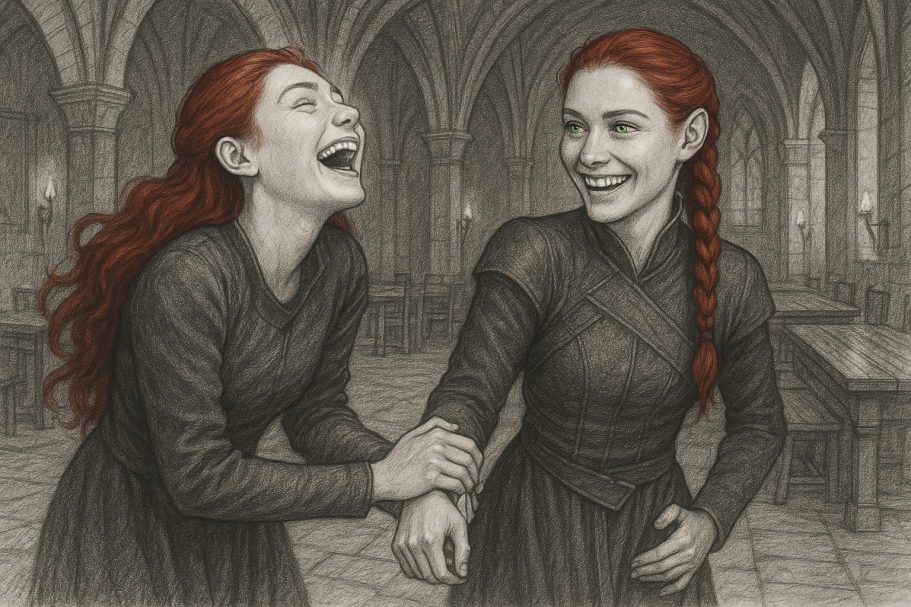
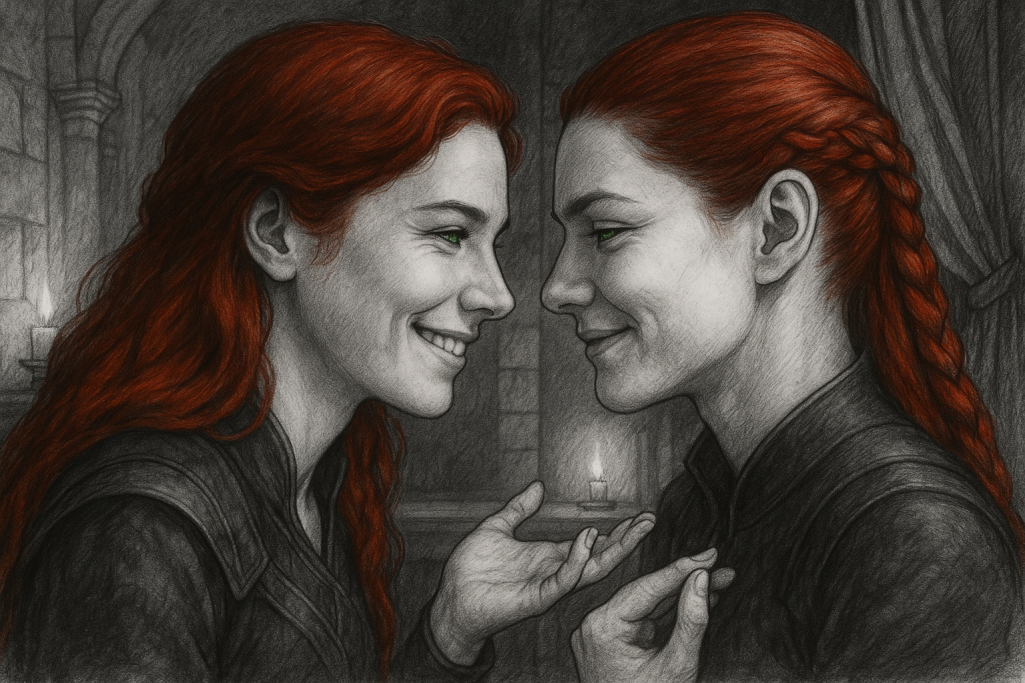
She was born with a twin. Sinatu. Green eyes, red hair, the same face, a completely different relationship with the cave from the very first morning.
"She surfaces into the world with no memories, no history, no formed self — and the Elders provide a framework immediately and completely. She inherits it wholesale
because she has nothing else."
The First Morning.
The Burned Finger.
The Voice She Told to Be Quiet.
On Arranah's first morning of conscious existence, sunlight comes through the
shutter of her room. Something inside her — older than thought, older than language, older than the Elders' framework she has just been handed — says clearly: no.
She reaches toward the light anyway.
She burns her finger. Watches her skin blister and remake itself. Confirms she is
immortal. Goes back to sleep, satisfied.
It seems like a small thing. A curious newborn testing her limits. But I have come to understand — slowly, through the writing, through everything that follows — that it is the most important moment in the entire chronicles. Because the voice that said no was the only thing in Arranah's world that was purely and originally hers. Not the
Elders' framework. Not inherited wisdom. Her own knowing. Her instinct. And the first
significant act of her conscious life was to tell it to be quiet.
The cave doesn't always look like a cave. Sometimes it looks like a perfectly
reasonable decision made alone in a room on an ordinary morning.
Everything that follows in Arranah's story — across four books, across 300 years of her immortal life — traces back to that burned finger. Every wrong turn. Every moment she follows the map instead of the territory. Every time the voice inside her raises its hand and she looks away.
But I didn't know any of this when I started writing her. I was too busy building philosophy.
What I Built. What She Thought of It.
Before I begin writing a novel I establish what I call tenets — a set of principles that describe how a character understands and interacts with their world at the story's opening. Not personality traits. Not plot points. Deeper than that. The philosophical ground they are standing on. The shadows they currently believe are real.
For Arranah, I built something I was quietly proud of. An intricate philosophical
architecture about ontological neutrality and inherited frameworks and Platonic
epistemology and the journey of a consciousness that begins with no self and must build one from scratch inside a rigid ancient structure.
It was, I thought, rather good. Then I interviewed her.
The interview is part of my writing process. At a certain point in the drafting I stop and speak directly to the character — not as her author but as someone asking her genuine questions.
What do you want?
What are you afraid of?
What do you know that I haven't written yet?
Arranah was patient. She listened to my philosophical framework with the expression of someone watching a child explain something the child clearly finds very impressive.
And then she told me what she actually cared about.
ARRANAH — INTERVIEW, ACT ONE
"I am not interested in old guys with beards and robes."
I had spent weeks on the philosophical framework. Weeks. Old guys with beards and robes. She was not finished:
"What I need is to understand where I stand within the
sisterhood. What Sinatu and I are to each other and whether that is allowed.
And I need to know why the Elders'
account of the world keeps failing to match what I can see with my own eyes.
That is what I am dealing with. The rest is your business, not mine."
She was right.
Of course she was right.
She had been alive for approximately three chapters and she was already clearer about herself than I was.
The philosophy didn't disappear. It went underground, where it belonged — into the structure of the story, into the bones of her arc, into the long slow shape of who she is becoming across four books. But the surface of the novel, the living breathing daily reality of Arranah's existence, was about three things: her standing in the sisterhood, her love for Sinatu, and the growing gap between what the Elders tell her the world is and what she can see it actually is.
The cave. And whether she will ever find the courage to walk toward the light.
Sinatu. Who Was Already Outside.
Arranah's twin is the most important character in the book and the quietest one.
While Arranah is struggling with the gap between the Elders' map and the territory — while she is suppressing the inner voice that keeps being right, maintaining the performance of the good obedient sister, watching the cracks spread through the official account of the world — Sinatu has already done something different.
Not louder. Not more rebellious. Sinatu does not challenge the sisterhood directly. She simply never fully entered the cave in the first place. Her relationship with her own instinct was never severed on a first morning with a burned finger. She trusts what she knows. She acts from it. She waits for Arranah to arrive at the same place.
All book, Sinatu waits.
When I interviewed Sinatu she said almost nothing. She looked at me for a long
moment and then said:
SINATU — INTERVIEW, ACT ONE
'She'll get there. She just needs to stop being so afraid of what she already knows.'
I asked her what Arranah was afraid of. She looked at me as though the answer was obvious.
'Losing us. The sisterhood is the only world she has.
She thinks if she becomes herself — really herself — she'll have to leave it.
Or it will leave her.
She doesn't know yet that the two things aren't incompatible.
That you can be fully who you are and still belong.
I know that. I've always known it.
But I can't give it to her.
She has to find it herself.'
I sat with that for a long time. Because Sinatu had just described, more precisely than I had managed in several thousand words of philosophical planning, the entire
emotional engine of the novel.
The cave is not just Plato's cave. It is the specific terror of losing the only world you know if you become the person you actually are.
And the light is not just enlightenment. It is the discovery that you can be both. Fully yourself and still belong.
Arranah gets there. It costs her enormously. But she gets there.
And Then There Is Her Daughter.
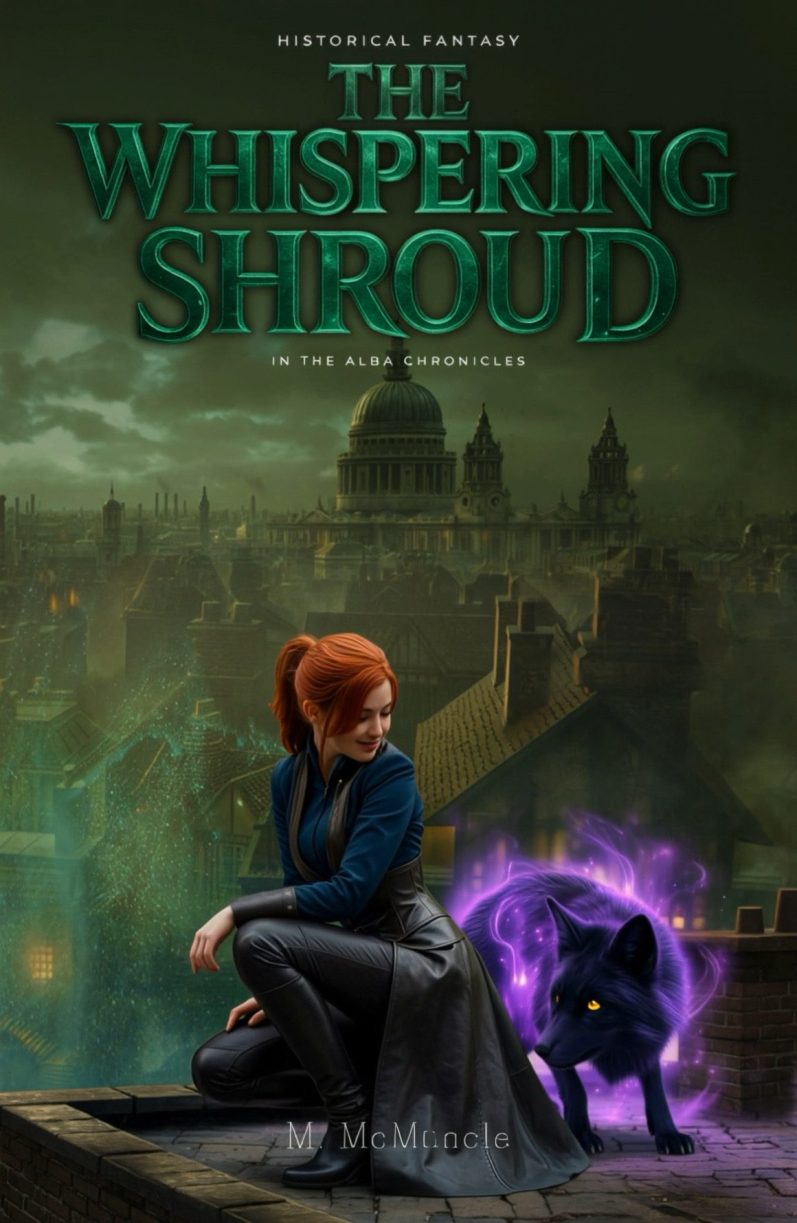
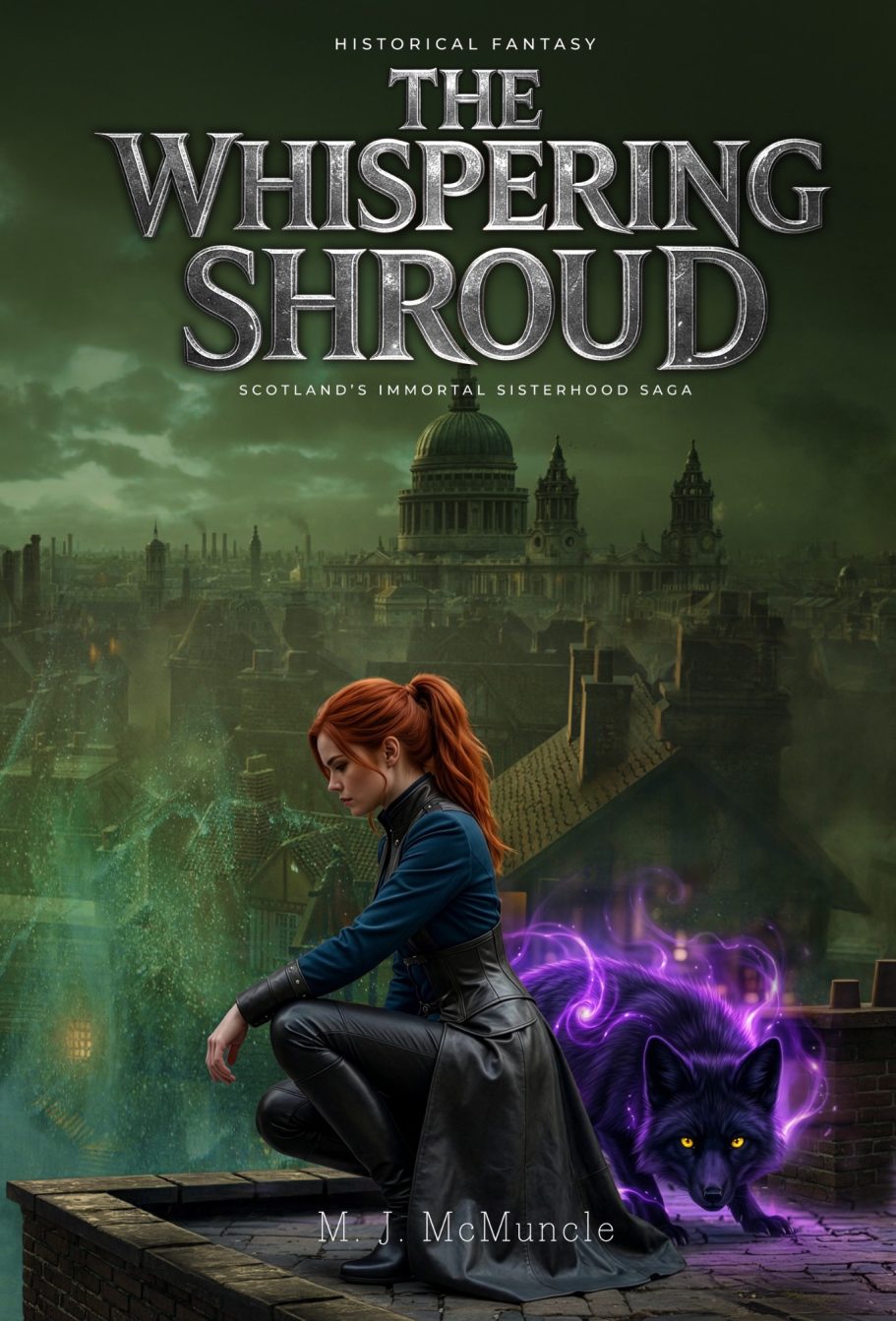
300,000 years later, in Victorian London, 1888, a woman named Kori is hunting a killer through the streets of Whitechapel during the murders that will make the name Jack the Ripper infamous.
Kori is Arranah's descendant. And she is old. Genuinely, incomprehensibly,
geologically old. Where Arranah was a newborn feeling her way through her first
century, Kori has been alive so long that philosophy has stopped being something she thinks about and become something she simply is.
She does not reach toward self-knowledge. She has already arrived. 300,000 years ago, at the very beginning of the bloodline, Arranah burned her finger in the sunlight and paid the price of ignoring her inner voice across 300 years of her short immortal life. Kori carries that inheritance in her bones without knowing its name.
The result is a woman who does not agonise. She does not philosophise. She does not stand at the shutter wondering whether to reach toward the light. She operates on pure observable fact. The city is a body. Read symptoms, not stories. Trust what you can see and measure. Never vibes without evidence.
She is not enlightened in any soft, luminous sense. She is the end product of 300,000 years of a bloodline learning, slowly and at enormous cost, what Arranah first began to understand on the Cuillin when she looked at the Grey Man and chose not to kill him. That the inner voice is not the enemy.
That instinct is not weakness. That the cave — however warm, however familiar,
however much it feels like home — is still a cave.
Plato's prisoner escaped and was blinded by the sunlight. Kori has been standing in the sunlight for so long she has forgotten what the cave looked like. She is not
Arranah's lesson learned. She is Arranah's lesson completed — by time, by lineage, by the slow accumulation of everything every woman in the bloodline between them chose or failed to choose.
When I interviewed Kori — which I also did, because this is apparently how I write now — she was characteristically direct.
KORI — INTERVIEW, ACT ONE, THE WHISPERING SHROUD
'I'm not here for the philosophy. There are women being murdered in Whitechapel
and the thing responsible is older
and more dangerous than anything Scotland Yard has a category for.
I need to stop it before Scrabs gets hurt.
The rest of this — "
she gestured at my carefully prepared thematic framework
" — is yours. I just need to do the work.'
This is what I mean when I say my characters went on strike. They didn't stop
working. They worked harder than I did. They simply refused to work on anything
except what was true.
And every time I listened — every time I put down my philosophical scaffolding and asked the character what she actually needed — the novel got better. Faster. Truer. More itself.
Every time I put down my philosophical scaffolding and asked the character what she actually needed — the novel got better. Faster. Truer. More itself.
What This Has To Do With You.
You don't have to be writing a nine-book series about immortal Scottish women for this to be relevant. Although I do recommend it. The kelpies alone are worth it.
Every character you have ever written — every character anyone has ever written — has a version of this tension inside them.
Between the author's intention and the character's truth. Between the philosophical framework and the lived reality. Between the cave as constructed and the light as glimpsed.
The question is whether you are listening.
Arranah tried to tell me things from very early on.
She reached toward the sunlight on her first morning and something in her said no and she overrode it.
She looked at the Grey Man on the Cuillin — a vast spirit guardian older than any law the Elders had written — and something in her said do not kill this creature and she listened, this time, and chose not to.
She found Mellusa's broken seal in the library and something in her said this is
important, this changes everything, and she was right.
The inner voice was right every single time. And every time she suppressed it, it cost her something.
The voice in your characters is doing the same thing. It is raising its hand. It is asking for an interview. It is waiting for you to stop explaining the cave and start following the light.
I have learned, slowly and at some cost, to let them lead.
The philosophy follows. It always follows. It just needs the character to go first.
The Alba Chronicles follows Arranah, Sinatu, and their descendants across deep time — from the ancient Alba of Lewis and Skye, through to the Mongol invasion of Japan, then Victorian London, and into prehistory. The Whispering Shroud, featuring Kori in 1888 London, is available now. Arranah's story, Sisters. Deathless. Twins, is forthcoming.
These essays explore the writing methodology behind the series — the character
interviews, the philosophical frameworks, and what happens when the characters have better ideas than their author. New essays published irregularly, whenever a character has something to say.
M.J. Muncle is the author of The Alba Chronicles.
He writes about immortal women, ancient Scotland, and the philosophical architecture of fiction.
He can usually be found somewhere between a manuscript and a surfboard.